Battery fires are more common than you think.
The lithium-ion fire problem is bigger than the record shows, and growing fast. A March 2026 NIST study pieced together eight fragmented datasets and estimated that 198,000 battery fires have occurred in the US since 2011, with consumer fires up about 10% a year and EV fires roughly 45% (Link).
Safety failures have become one of the most consequential challenges facing the entire industry as energy storage scales massively across data centers, electric vehicles, aviation, medical devices and consumer electronics. This will be further exacerbated by the AI infrastructure rollout.
The root causes of most battery incidents are thermal runaway, dendrite-induced short circuits and flammable liquid electrolytes. These aren’t simply marginal engineering flaws. They are structural, chemical-level vulnerabilities that have been baked into lithium-ion technology since its inception. Each new deployment at scale amplifies the risk.
In Europe, battery safety, manufacturing resilience and next-generation chemistries have become strategic priorities through initiatives such as Battery 2030+ and Horizon Europe, which identify safer, more sustainable and higher-performing battery technologies as critical to Europe’s industrial future. Yet the fundamental safety problem remains unsolved, rather than eliminating the risk, the world has settled for managing it.
Why incremental fixes cannot solve the problem
Lithium-ion cells store energy in a chemical manner that’s inherently difficult to contain. They are flammable due to volatile liquid electrolytes and reactive electrode materials, so the safety challenge is structural, and the thermal runaway risk is ever-present. They can violently ignite when overcharged, under mechanical constraint or exposed to elevated temperature.
Most people are aware of smoldering consumer devices following near misses with lithium-ion batteries on flights but less well known are the catastrophic fires in grid-scale storage and data center racks.
Sodium-ion chemistry is often promoted as the safer alternative. They can be discharged down to zero volts; they are less prone to dendrite formation and the cathode material tends to release less oxygen. While this technology softens the problem, it still depends on flammable liquid electrolytes and remains susceptible to thermal runaway.
Solid-state electrolytes were expected to be the answer as eliminating the liquid reduces flammability. However, most leading solid-state approaches target metallic lithium anodes, which introduces a new hazard in the form of dendrite growth. This can pierce the electrolyte and cause internal short circuits, and so the safety trade-off shifts.
Manufacturing compounds the problem because lithium-based materials are reactive and moisture-sensitive. This means they must be processed in expensive dry rooms under restrictive conditions to prevent contamination and process deviations. Both major sources of field failures and safety recalls.
The answer isn’t a safer version of lithium chemistry, but a different chemistry altogether where safety is intrinsic rather than an engineered afterthought.
Enter Pioniq: from fundamental physics to a new battery platform
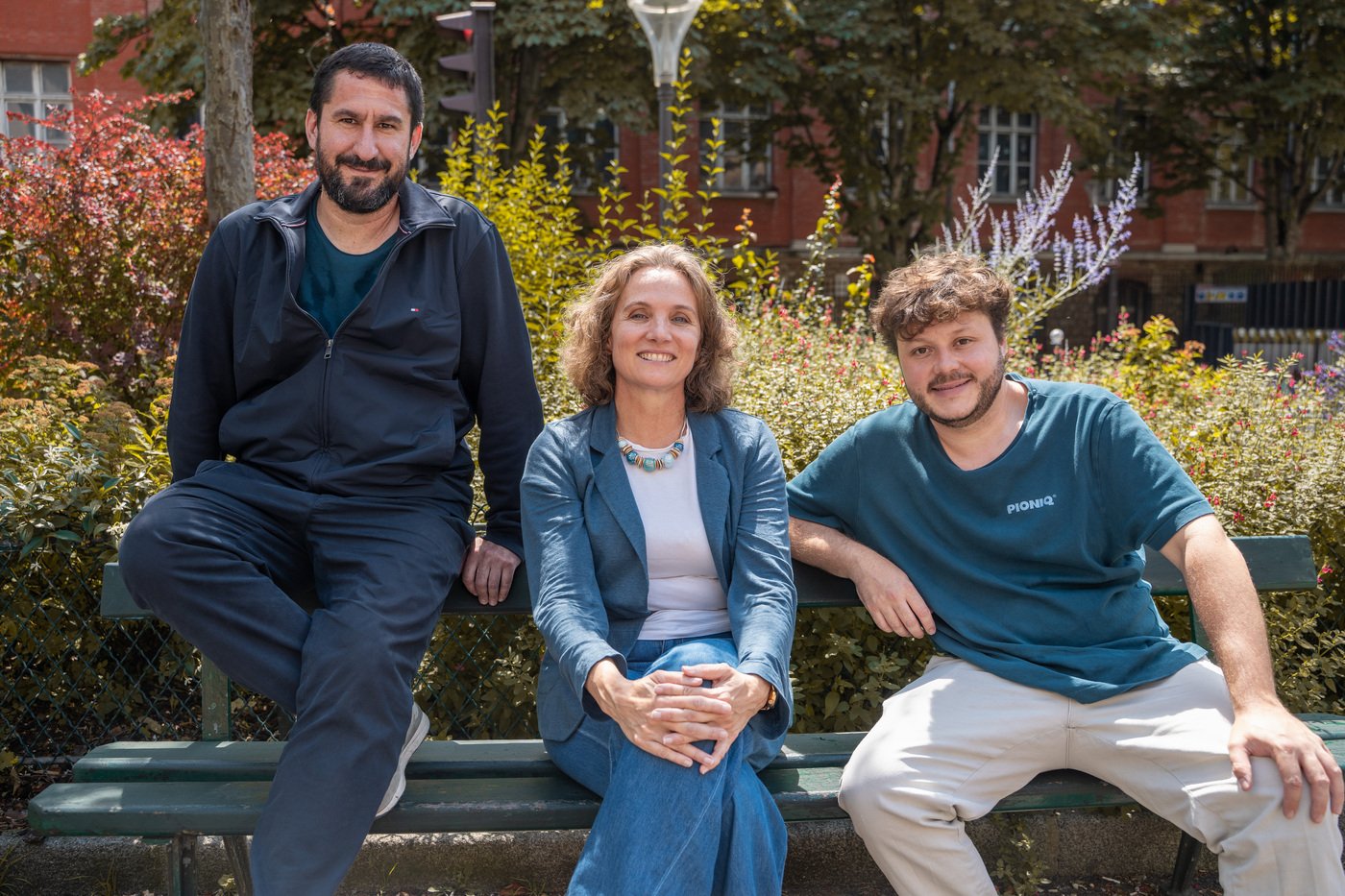
From left to right, Clément Barraud (COO), Brigitte Leridon (CEO) and Rémi Federicci (CTO)
Pioniq was founded in early 2024 by three physicists. Brigitte Leridon, Rémi Federicci and Clément Barraud dedicated years to fundamental research on quantum materials, which led to a materials breakthrough. The trio discovered a new class of solid-state electrolytes in which charge transport is a quantum-mechanical phenomenon.
We call them quantum electrolytes and they are the foundation of the world’s first battery built on this principle.
What is actually “quantum” about it?
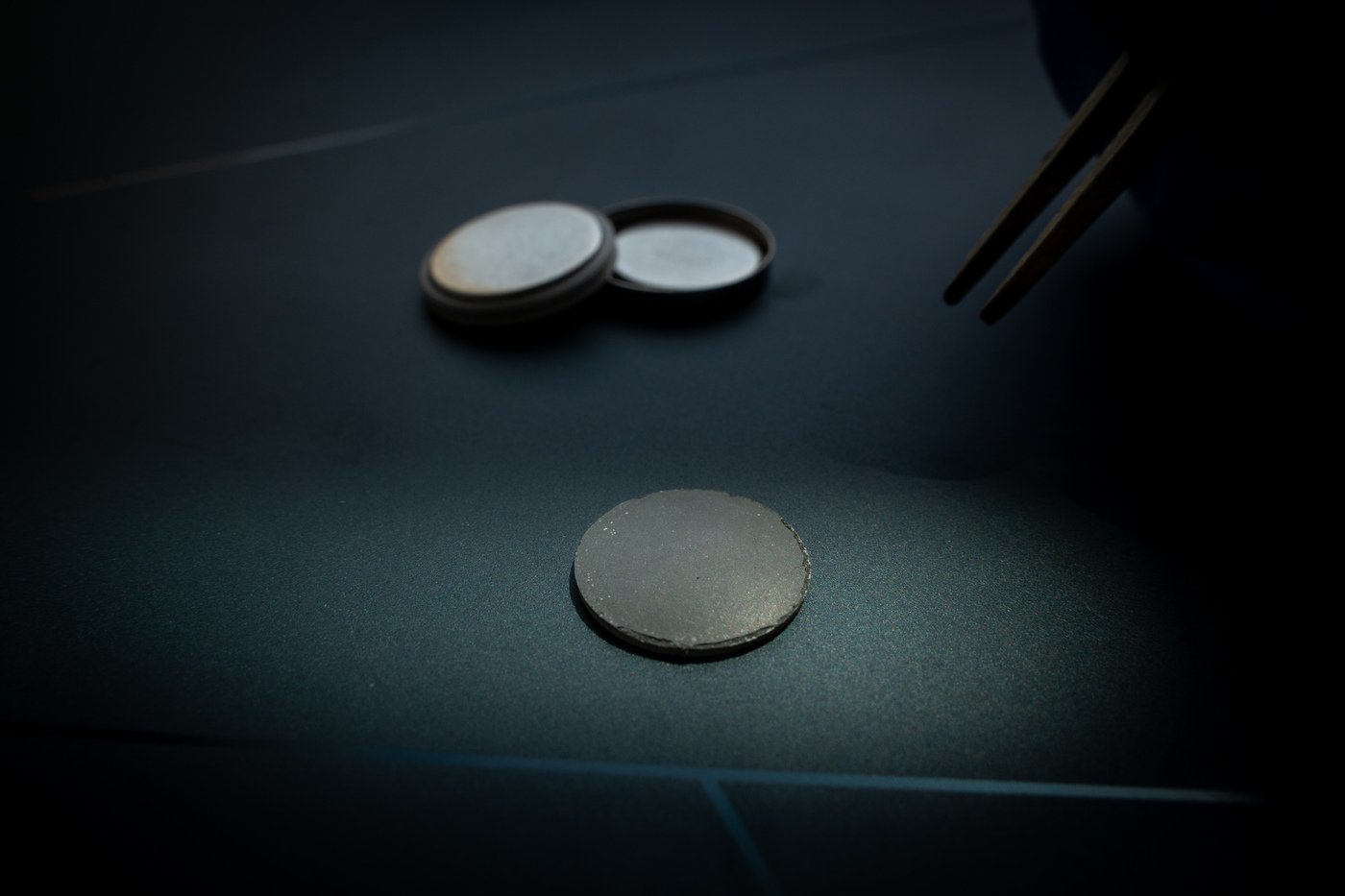
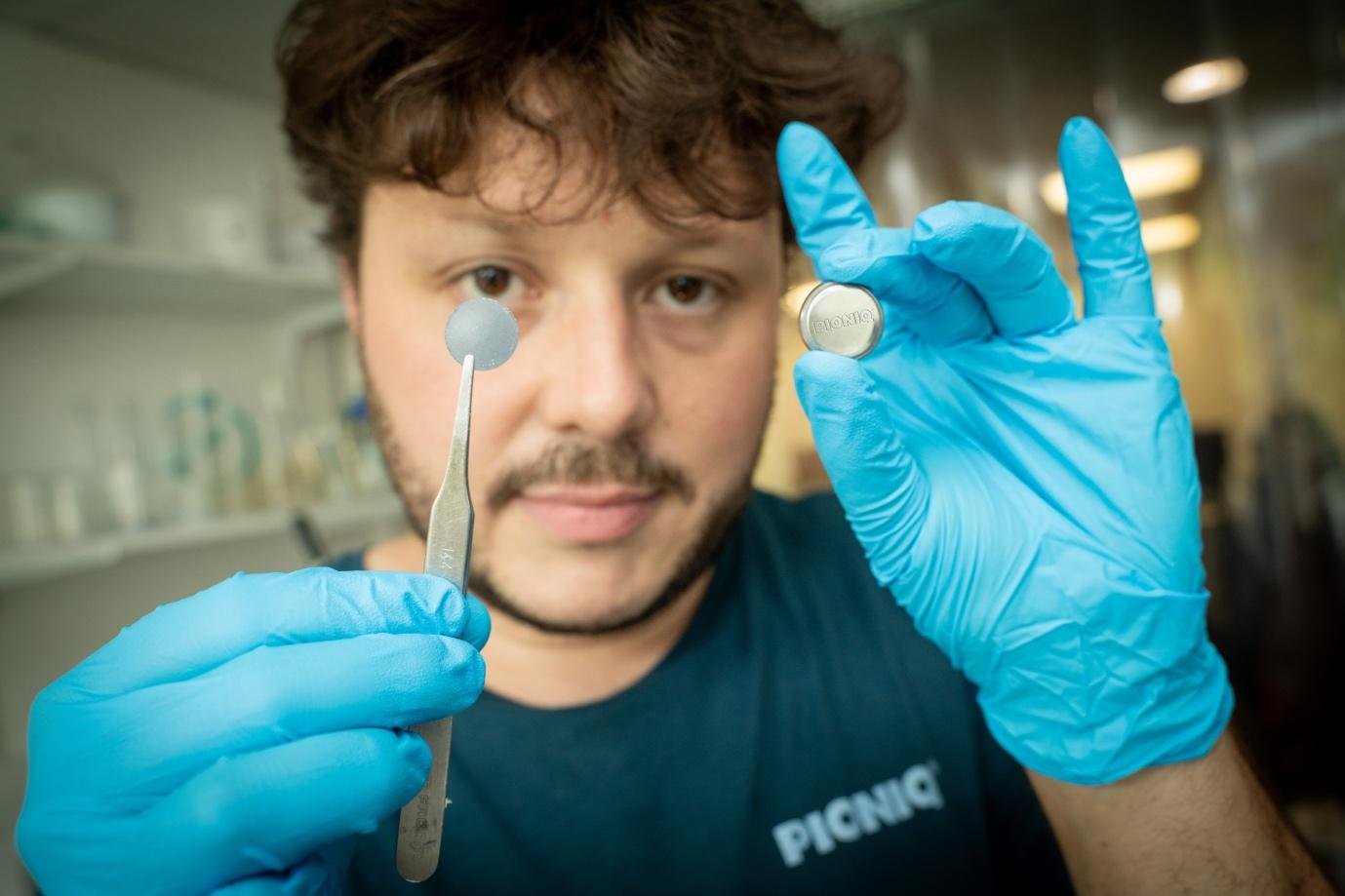
Quantum electrolytes are solid crystalline proton conductors that are derived from the perovskite family and are synthesized from abundant oxide precursors. There’s no liquid or metallic lithium, so there’s no flammable component of any kind.
In a conventional electrolyte, solvated ions migrate through a liquid medium, which is the very mechanism that creates the conditions for leakage, ignition and thermal runaway. Conduction works differently with quantum electrolytes.
In such materials, nearly-free protons move through the crystalline lattice by quantum-assisted transport. Water molecules are structurally incorporated into the crystalline material and self-organized into 1-D chains that are prone to proton conduction by quantum-tunneling effects between sites.
Recent atomistic and quantum-mechanical modeling results support a picture in which proton conductivity arises from dynamically reconfiguring hydrogen-bond networks, where structural fluctuations lower proton hopping barriers and favor Grotthuss-type transport (Link / Link).
The charge carrier is a proton moving through a solid oxide framework, so there’s no liquid to heat, no vapor to ignite and no runaway reaction to initiate. This also changes the interfacial electrochemistry as well. This is particularly relevant for zinc-based batteries, one of the most promising next-generation chemistries thanks to their potential for low cost, sustainability and improved safety, but historically limited by poor reversibility and parasitic reactions. In zinc–metal oxide and zinc–air cells, the quantum electrolyte suppresses these degradation mechanisms, enabling reversible charge transfer and stable cycling.
Safety means little if the battery cannot compete on performance. Pioniq’s current prototypes deliver:
- Volumetric energy density of 600 Wh/L projected on the first generation of devices, with a short-term roadmap toward 1,200 Wh/L
- Estimated lifetime > 3,000 cycles
- Operating temperatures: -30°C to +80°C
- Rapid charging times (1C-10C)
Safer chemistry means simpler manufacturing
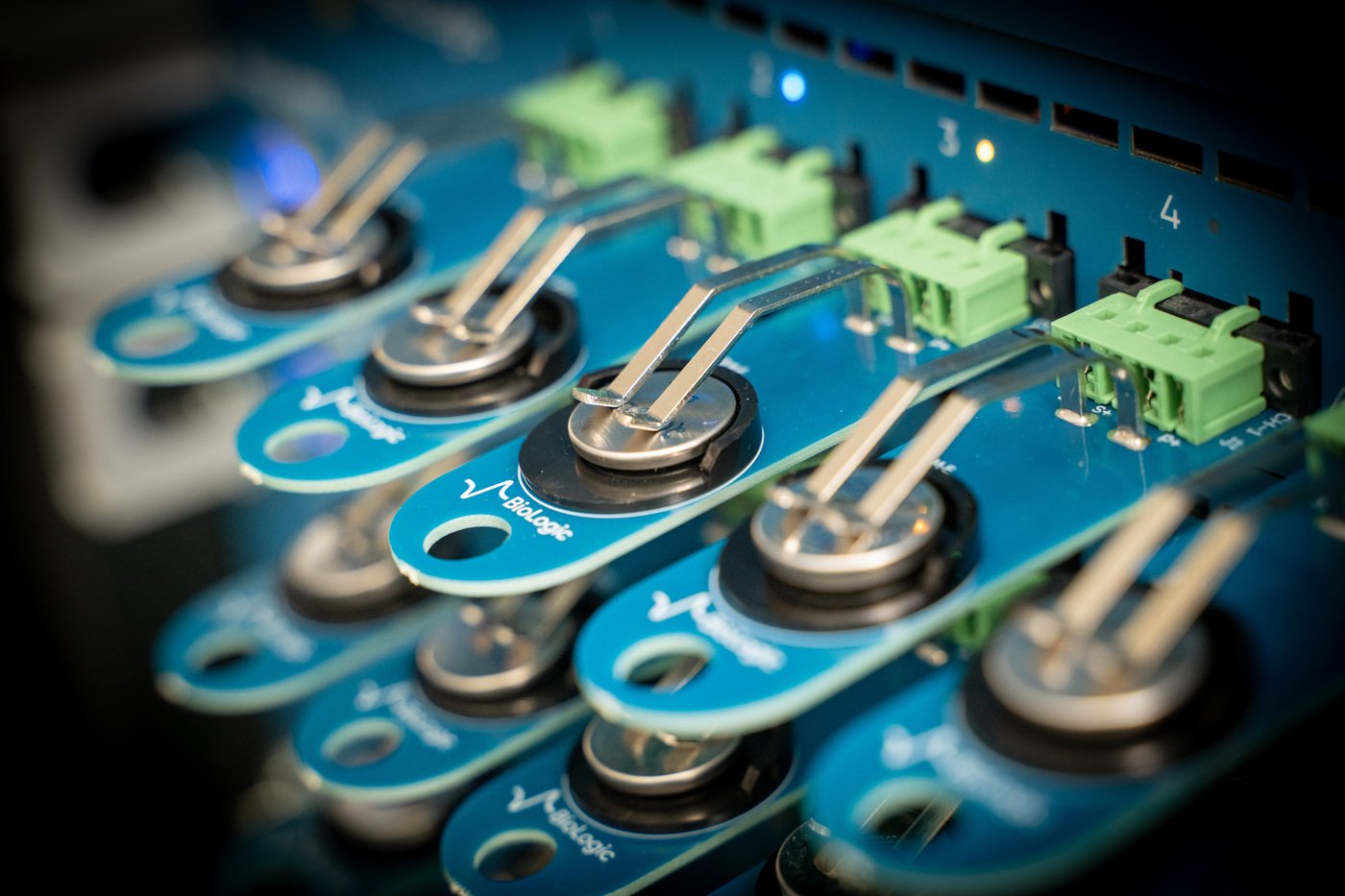
Pioniq’s quantum electrolytes share strong similarities with ceramic materials that are already produced in mature industrial processes. Both the electrolyte and the electrode materials can be processed under ambient conditions and shaped using conventional manufacturing routes. This means there is no need for dry rooms, inert atmospheres or hazardous precursors in the supply chain.
This simplicity compounds, so new electrode materials, cell designs and chemistries can be fabricated and tested in days rather than weeks. This will allow for rapid iteration and accelerated validation that’s less capital-intensive, easier to scale and faster to develop.
The approach also aligns with Europe’s broader ambition to build a competitive battery industry based on safer chemistries, resilient manufacturing and reduced dependence on critical raw materials.
The proof is in our own trajectory. In fewer than two years, a lean scientific team took a laboratory discovery to functional battery prototypes, validated the underlying technology, developed first pre-products and established collaborations with major industrial partners. Simplifying the chemistry simplified the engineering.
We are targeting use cases where safety is non-negotiable, across both defense and civil markets:
- SMD-format micro-batteries integrated into electronics and IoT devices operating in constrained environments
- Large-format cells for safety-critical deployments: in-rack GPU protection in data centers and autonomous defense systems
In these markets a single thermal runaway event can be catastrophic thus intrinsic safety is a requirement. Beyond these safety and manufacturing advantages, the entire architecture is built on abundant, widely available oxide materials, so long-term supply resilience is a built-in property of the platform, not an aspiration.
What’s next
Pioniq has transformed a fundamental physics discovery into functional battery prototypes combining competitive energy density, stable cycling and, most importantly, safety that comes from the chemistry itself, not from workarounds layered on top of a hazardous core.
Pioniq is now scaling cell formats and partnering with industrial players to develop specific use-cases for electronics and BBUs for both defence and civil sectors and build industrial ramp-ups.
If you’re a scientist or founder building at the frontier of quantum technologies, you can reach to us. You can follow Pioniq’s journey here (Website / LinkedIn).